
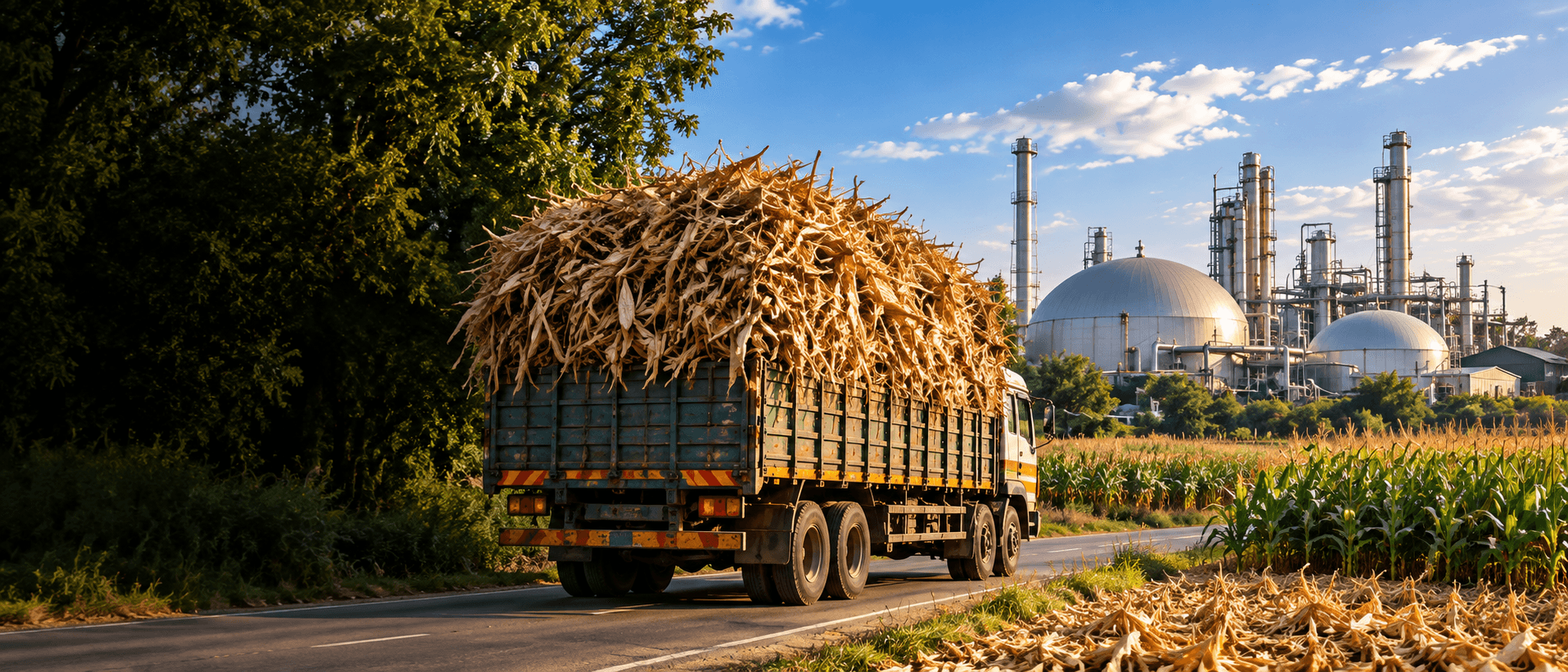
Crop-residue feedstock profile
Maize Stover for CBG: Collection, Quality and Plant-Fit Guide
Maize stover can diversify a crop-residue portfolio in maize-growing regions. Usable supply depends on harvest method, fodder demand, soil retention, clean collection and proven plant performance.
Source carefully
Verify surplus after fodder and field-retention needs.
Watch closely
Control soil, moisture, plant-part variability and losses.
Ask the supplier
Prove source, harvest method, format and monthly quantity.
Prepare for feeding
Screen, chop and validate plant compatibility.
Why maize stover matters
A useful diversification feedstock, when the cluster is proven
Maize stover can complement other crop residues and reduce dependence on one harvest season. Its commercial value comes from measured recoverable surplus, clean collection, dense transport, controlled storage and a plant-approved blend range.
Diversifies feedstock
Supports residue income
Adds regional supply
Complements co-feed
Plant-fit rule
Source + quality + preprocessing + trial
No source cluster becomes execution-ready until all four gates carry dated evidence and plant sign-off.
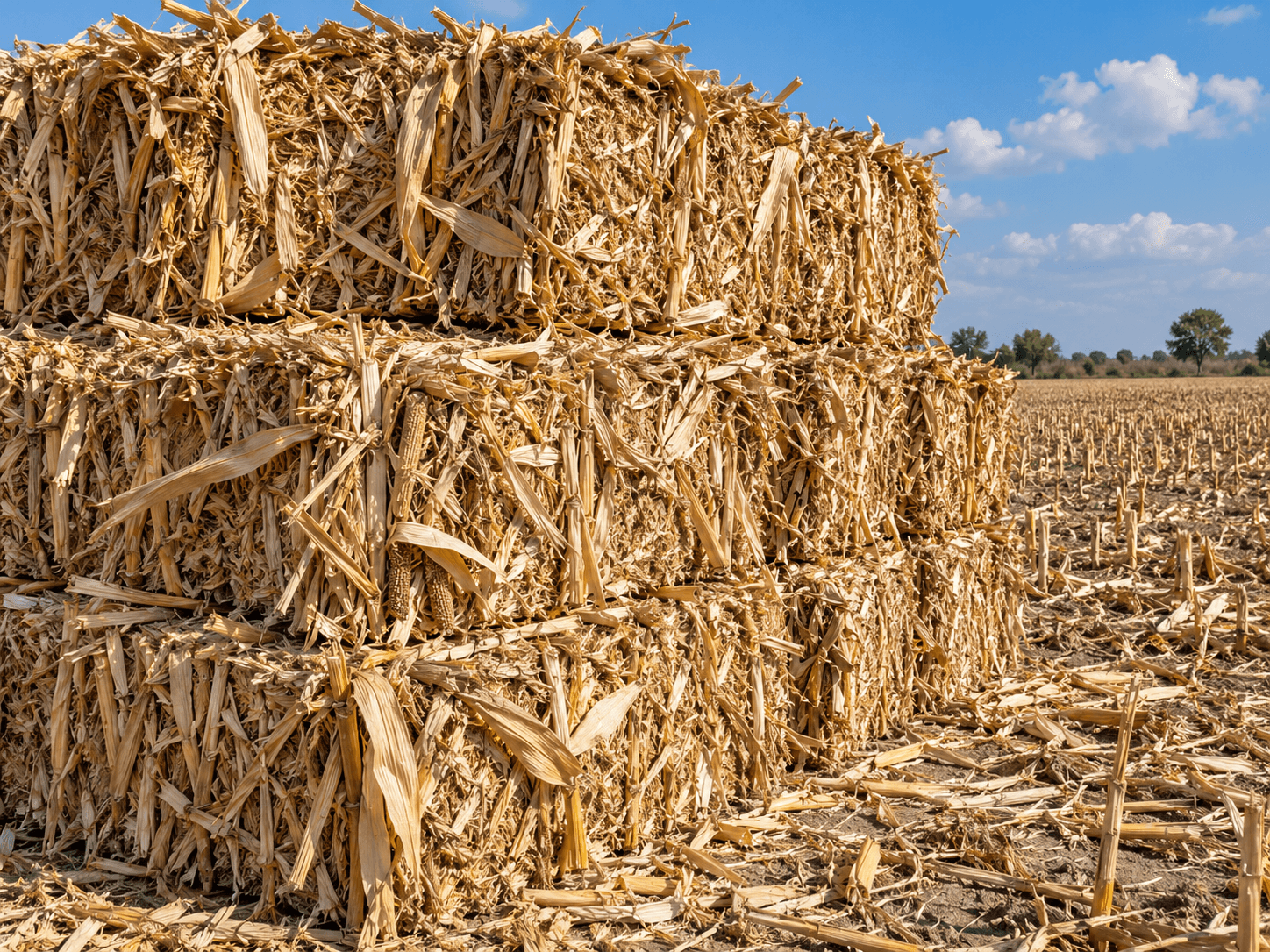
Key feedstock metrics
Planning inputs that must be validated locally
Indicative values vary with crop variety, harvest method, collected plant fraction, weather and storage conditions.
30-50%
Indicative dry-matter range at collection; validate locally
3-6 weeks
Typical main collection window after grain harvest
Moderate
Storage sensitivity to moisture, mould and fire
Chop + screen
Common preparation before controlled plant feeding
120-200 kg/m3
Indicative transport density for rectangular bales
Plant trial
Required before a cluster becomes contracted supply
Procurement workflow
Prove the chain before contracting annual tonnes
A seven-gate workflow turns a satellite lead into accepted, traceable feedstock.
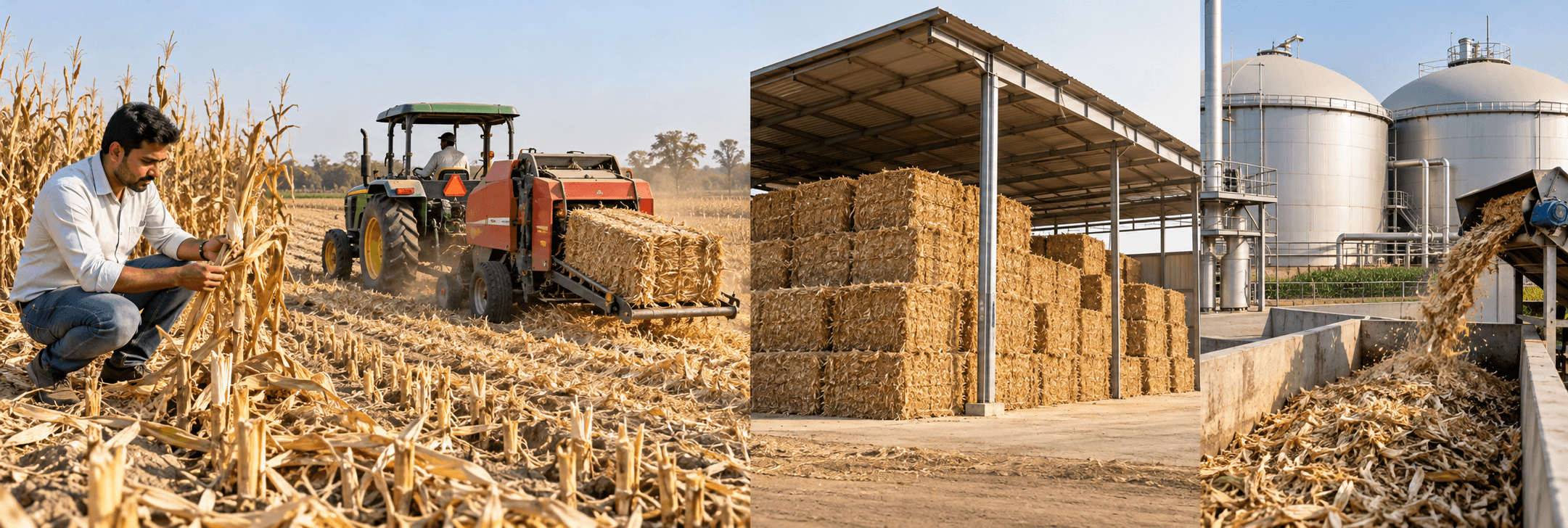
- 1
Satellite lead
Identify maize clusters and likely harvest windows.
- 2
Field survey
Verify acreage, access, uses and collectable surplus.
- 3
Supplier commitment
Agree quantity, format, quality and delivery terms.
- 4
Baling and aggregation
Collect cleanly and assign digital lot identity.
- 5
Quality screening
Check moisture, soil, mould and prohibited material.
- 6
Storage and dispatch
Preserve dry inventory and plan route-level movement.
- 7
Controlled plant trial
Validate throughput, blend range and gas contribution.
Quality parameters
Receiving and traceability controls
Set contract limits from plant design and controlled trial evidence.
| Parameter | Typical range / guidance |
|---|---|
| Dry matter at collection | 30-50% planning range; harvest-method dependent |
| Contaminants | Target below 5%; plant contract may be stricter |
| Ash / silica | Characterize representative source-cluster samples |
| Baled bulk density | Approximately 120-200 kg/m3 |
| Particle size after preparation | Typically 10-50 mm; plant-specific |
| Undesirable material | Reject plastic, metal, stones, mould and burnt residue |
| Traceability | Source cluster, harvest date, lot ID and receiving evidence |
Storage and fire safety
Keep dry inventory stable and accessible
Poor storage can erase the value created during clean collection.
- Store on raised, well-drained platforms with roof or engineered weather protection.
- Use breathable covers and maintain ventilation around every stack block.
- Keep stack spacing, fire breaks and clear emergency access routes.
- Monitor moisture ingress, internal temperature, mould and inventory age.
- Keep ignition sources away and maintain water access and response equipment.
- Apply first-in, first-out dispatch and document every damaged or rejected bale.
Preprocessing and plant readiness
Create a consistent feed fraction
Size reduction improves handling; only trials prove digestion performance.
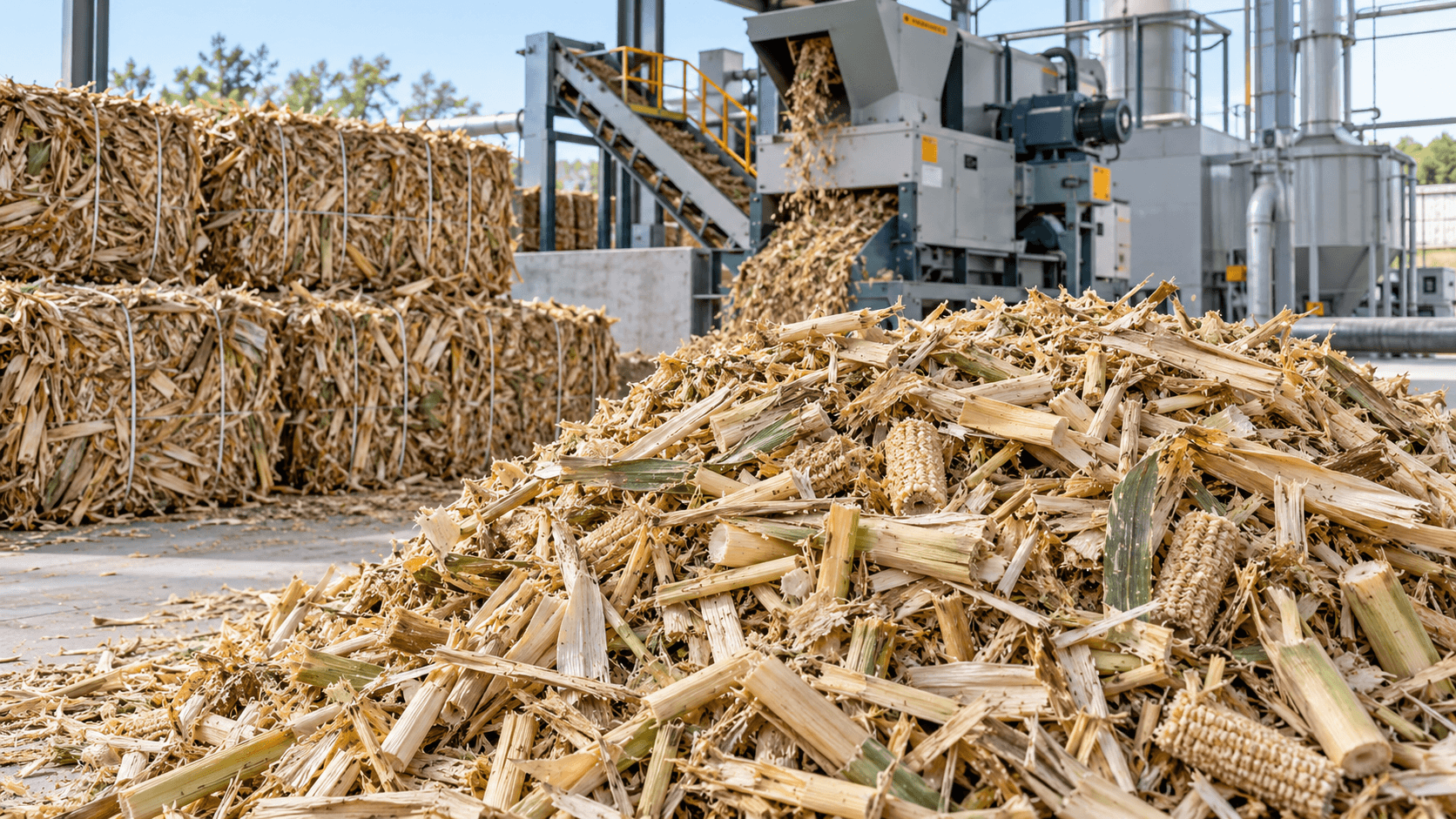
Approval gates
- Stable unloading and conveying
- Consistent screened particle size
- Approved blend and feed rate
- Measured gas and digestate response
Availability and seasonality
Major maize belts and an autumn-led harvest window
State context is a lead only. Procurement capacity must be proven at district and source-cluster level.

Major maize-growing states
- 1Uttar Pradesh
- 2Bihar
- 3Madhya Pradesh
- 4Maharashtra
- 5Rajasthan
- 6Karnataka
- 7Telangana
- 8Andhra Pradesh
Indicative monthly availability
Economics
Indicative delivered-cost stack
Recalculate for distance, bale density, accepted weight and regional conditions.
| Parameter | Typical range / guidance |
|---|---|
| Farm-gate price | INR 800-1,500/t |
| Collection and baling | INR 300-700/t |
| Transport within region | INR 400-1,200/t |
| Chopping / screening | INR 200-500/t |
| Indicative delivered cost | INR 1,700-3,700/t |
These are planning ranges, not live supplier quotes. Verify current cluster prices, equipment utilization, fuel, loading time and rejection loss.
Processing and pretreatment
Choose the least-complex process that meets plant performance
Every process adds cost and operating risk; approve it through measured throughput and digestion trials.
Chopping / shredding
- Reduce particle size
- Improve conveying
- Limit floating layers
Grinding / milling
- Increase surface area
- Check energy demand
- Monitor equipment wear
Ensiling / co-feed
- Useful for mixed recipes
- Preserve suitable material
- Validate storage stability
Advanced pretreatment
- Plant-specific chemistry
- Evaluate safety and cost
- Approve through trials
How URJA SETU adds value
One evidence chain from satellite lead to buyer acceptance
Bhoomi Drishti
Satellite-led cluster identification
URJA Vision
Supply visibility and planning evidence
Traceability
Source, lot, quality and weight records
Smart hubs
Aggregation and logistics control
Feedstock intelligence
Crop-residue planning by plant
Buyer support
Plant-specific sourcing governance
FAQ
Common maize-stover planning questions
How much maize stover is actually available?+
Do not use total residue generation as supply. Deduct fodder demand, field-retention needs, inaccessible fields, competing buyers and collection losses, then prove the remainder through harvest-time pilot collections.
What affects collectable surplus?+
Harvest method, crop variety, grain moisture, field access, farmer use, soil-management needs, labour, baler availability and weather all change the usable quantity.
How should maize stover be stored?+
Use dry, covered, ventilated stacks on raised drained surfaces with temperature and moisture checks, fire breaks, clear access and first-in, first-out dispatch.
Can maize stover be mixed with other feedstocks?+
Potentially, but the inclusion range must be approved through representative laboratory work and controlled plant trials. Do not transfer a blend recipe from another plant or district.
Does maize stover need preprocessing?+
Most plants will require controlled size reduction and screening. Exact particle size and pretreatment depend on receiving, conveying, mixing and digester design.
Is field validation necessary?+
Yes. A field-to-plant pilot is the minimum evidence for recoverable surplus, payload, contamination, handling cost, preparation throughput and stable plant use.
Ready to assess maize-stover supply for your CBG plant?
Use verified field evidence, supplier commitments, quality controls and plant trials to build a dependable supply plan.
All quantities, ranges and costs are indicative planning inputs, not a plant guarantee, engineering specification, live quote or supplier commitment. Validate local recoverable surplus, representative samples, storage controls and controlled plant trials with qualified professionals.
Evidence sources