
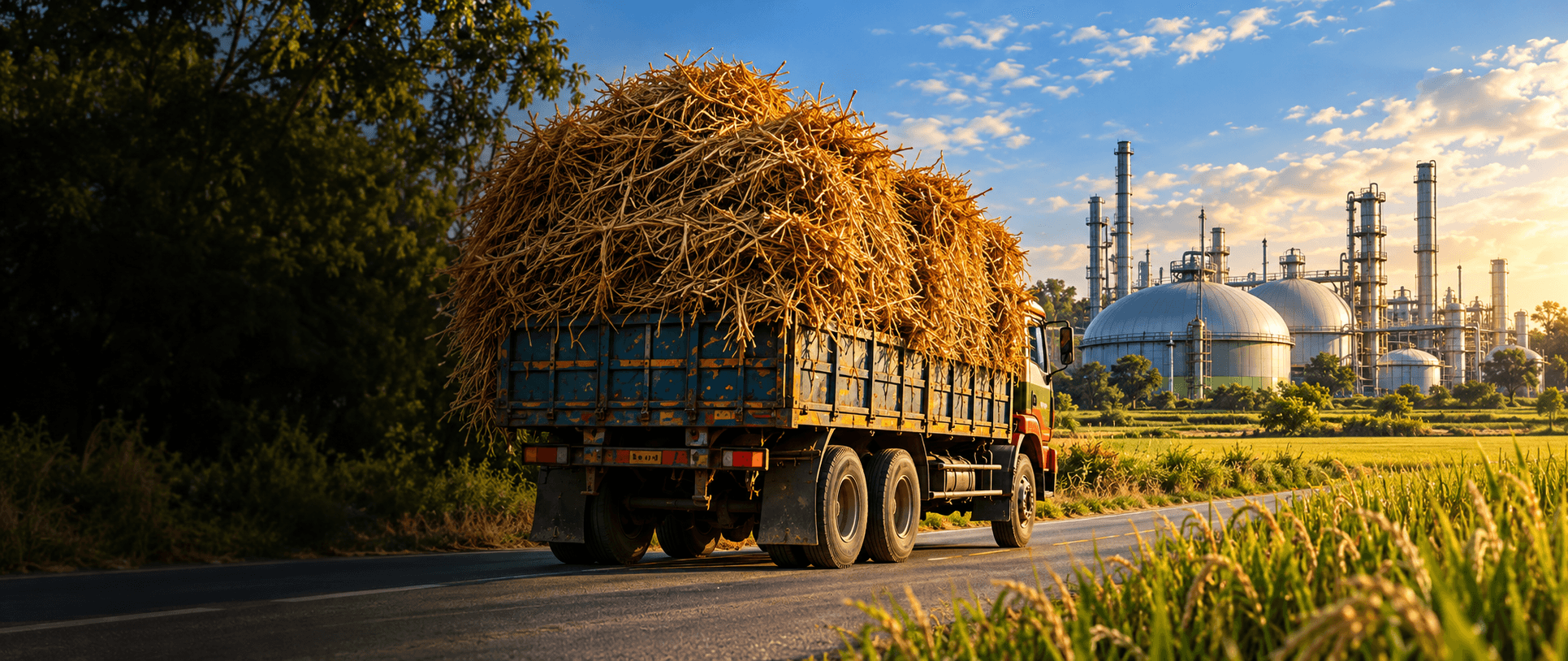
Crop-residue feedstock profile
Paddy Straw for CBG Plants: Procurement, Quality and Storage Guide
Paddy straw can anchor a large crop-residue programme in rice-growing belts, but the commercial result depends on a short collection window, dry handling, preprocessing and disciplined fire-safe storage.
Overview
Paddy straw: a valuable bioenergy feedstock
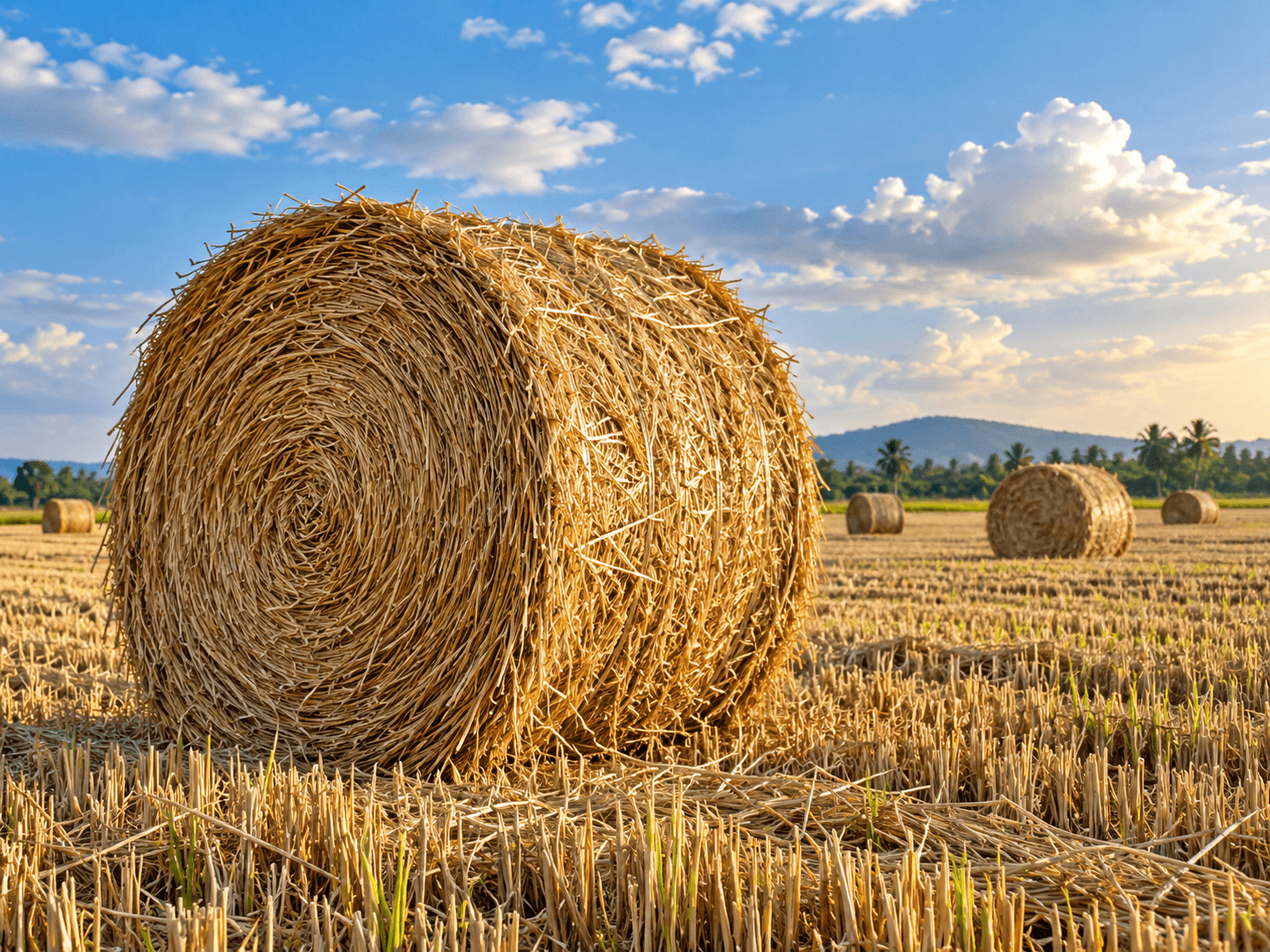
Paddy straw is an abundant agricultural residue with useful bioenergy potential. When collected, processed and stored properly, it can serve as a dependable CBG feedstock while reducing stubble burning and creating rural income. Commercial decisions must still be based on recoverable surplus, representative testing and verified local operations.
Abundant availability
Reduced field burning
Farmer income
CBG feedstock
Key facts
~10 t
Indicative straw per tonne of CBG
250-300 Nm3/t
Indicative raw biogas range
45-55%
Typical methane share in raw biogas
84-88%
Typical total solids on dry basis
Feedstock value chain
From field to CBG plant
A managed supply chain protects quality, lowers losses and makes production planning traceable.
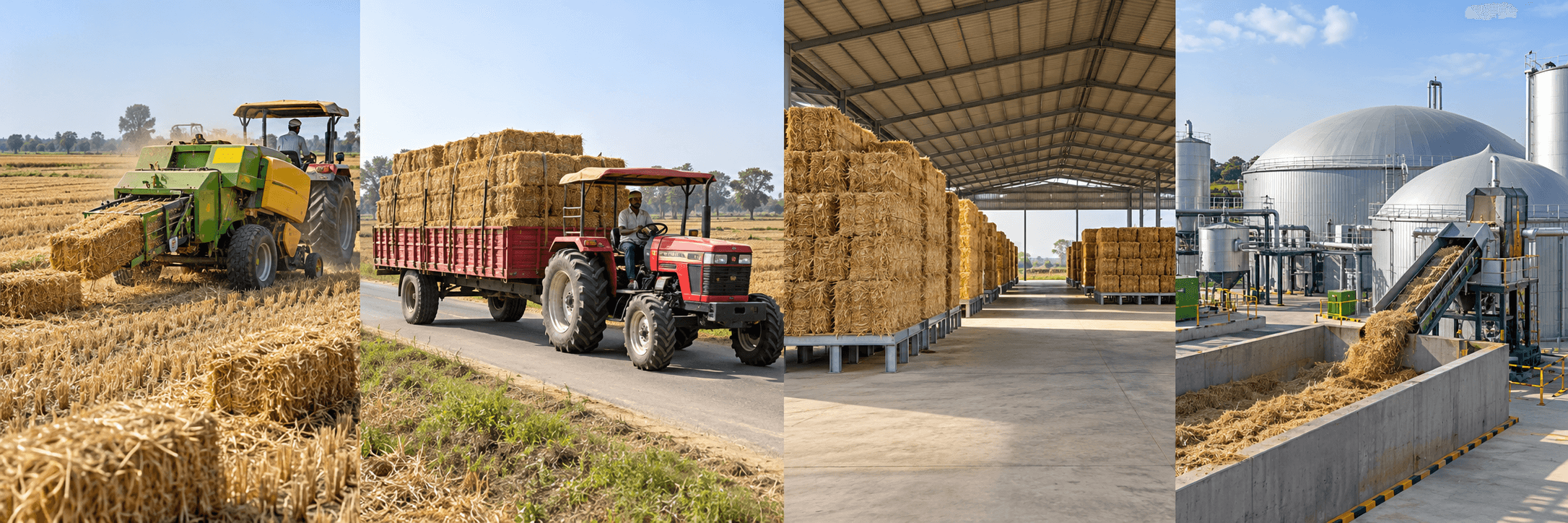
- 1Harvest & collection
- 2Baling & transport
- 3Storage & preprocessing
- 4Feeding to CBG plant
Feedstock specifications
Typical paddy straw properties
Indicative ranges vary by variety, region and season.
| Parameter | Typical range |
|---|---|
| Total solids (TS) | 84-88% |
| Volatile solids (VS) | 70-80% of TS |
| Moisture | 12-16% |
| C:N ratio | 60-100:1 |
| Ash content | 12-18% of TS |
| Lignin | 15-22% of TS |
| Silica | 5-10% of TS |
| Bulk density, baled | 100-180 kg/m3 |
Quality standards
Receiving controls
Contract limits must match plant design and trial results.
| Parameter | Planning recommendation |
|---|---|
| Moisture at receipt | Contract-specific; commonly <=15-20% |
| Foreign matter | Target <=2% |
| Chopped particle size | Typically 10-30 mm |
| Bale density | Target >=120 kg/m3 |
| Visible mould or rot | Reject |
| Sand and grit | Target <=2% |
| Storage duration | Prefer <=6-9 months with controls |
| Fire risk | High if unmanaged; controls mandatory |
Methane potential
Indicative conversion ranges
Actual yield depends on feedstock quality, preparation and digester design.
| Parameter | Typical range |
|---|---|
| Raw biogas yield | 250-300 Nm3/t |
| Methane in raw biogas | 45-55% |
| Indicative methane yield | 110-165 Nm3 CH4/t |
| Energy equivalent | 2.0-3.0 GJ/t |
| Theoretical CBG | 90-140 Nm3/t |
| Paddy straw per tonne CBG | Approximately 8-12 t |
Procurement & collection
Control the short harvest window
Field plans, lot identity and machinery capacity determine dependable volume.
- Work through mapped farmer groups and accountable local aggregators.
- Pre-book balers, loaders and trucks before the short harvest window.
- Prioritize field-cured straw and record moisture at source and receipt.
- Reject soil, stones, plastic, burnt residue and visibly mouldy bales.
- Link every load to field cluster, harvest date, bale count and weighbridge ticket.
Storage & handling
Preserve quality and prevent fire
Dry covered storage, stack monitoring and engineered fire controls are essential.
- Use raised, drained platforms with covered or engineered weather protection.
- Keep breathable stack covers, safe aisles and fire breaks between blocks.
- Monitor internal temperature, moisture ingress and inventory age.
- Keep ignition sources away and maintain water access and response equipment.
- Apply first-in, first-out dispatch and investigate every damaged stack.
Availability & seasonality
Major rice belts and a concentrated collection season
Treat this as planning context; build commitments from district field evidence and recoverable surplus.

Major rice-producing states
- 1Punjab
- 2Haryana
- 3Uttar Pradesh
- 4Bihar
- 5West Bengal
- 6Madhya Pradesh
- 7Chhattisgarh
- 8Andhra Pradesh
- 9Telangana
- 10Tamil Nadu
Typical monthly availability
Economics
Indicative delivered-cost stack
Model by region, season, density and route.
| Parameter | Typical range |
|---|---|
| Farm-gate price | INR 1,500-2,500/t |
| Collection & baling | INR 300-700/t |
| Short/medium transport | INR 300-800/t |
| Processing | INR 200-600/t |
| Indicative delivered cost | INR 2,300-4,600/t |
Planning ranges are not supplier quotes. Recalculate using current district evidence, fuel prices, loading time and accepted net weight.
Processing & pretreatment
Improve handling and digestibility
Select the least-complex process that meets verified plant performance and safety requirements.
Chopping
- 10-30 mm planning range
- Improves handling
- Reduces floating
Grinding / milling
- Faster hydrolysis
- Higher energy use
- Confirm equipment wear
Ensiling / co-feed
- Can preserve mixed feed
- Useful for wet co-feed
- Needs recipe validation
Advanced pretreatment
- Alkaline, thermal or enzymatic
- May improve biodegradability
- Validate cost and safety
Related resources
Evidence for the decision file
Official and sector references supporting this planning guide.
Plan your paddy straw supply chain
Model field availability, collection capacity, storage buffer and delivered cost for your plant location.
All quantities, ranges and costs on this page are indicative planning inputs. They are not a plant guarantee, engineering specification or supplier commitment. Validate local recoverable surplus, representative laboratory samples, fire and environmental controls, and controlled plant trials with qualified professionals.