
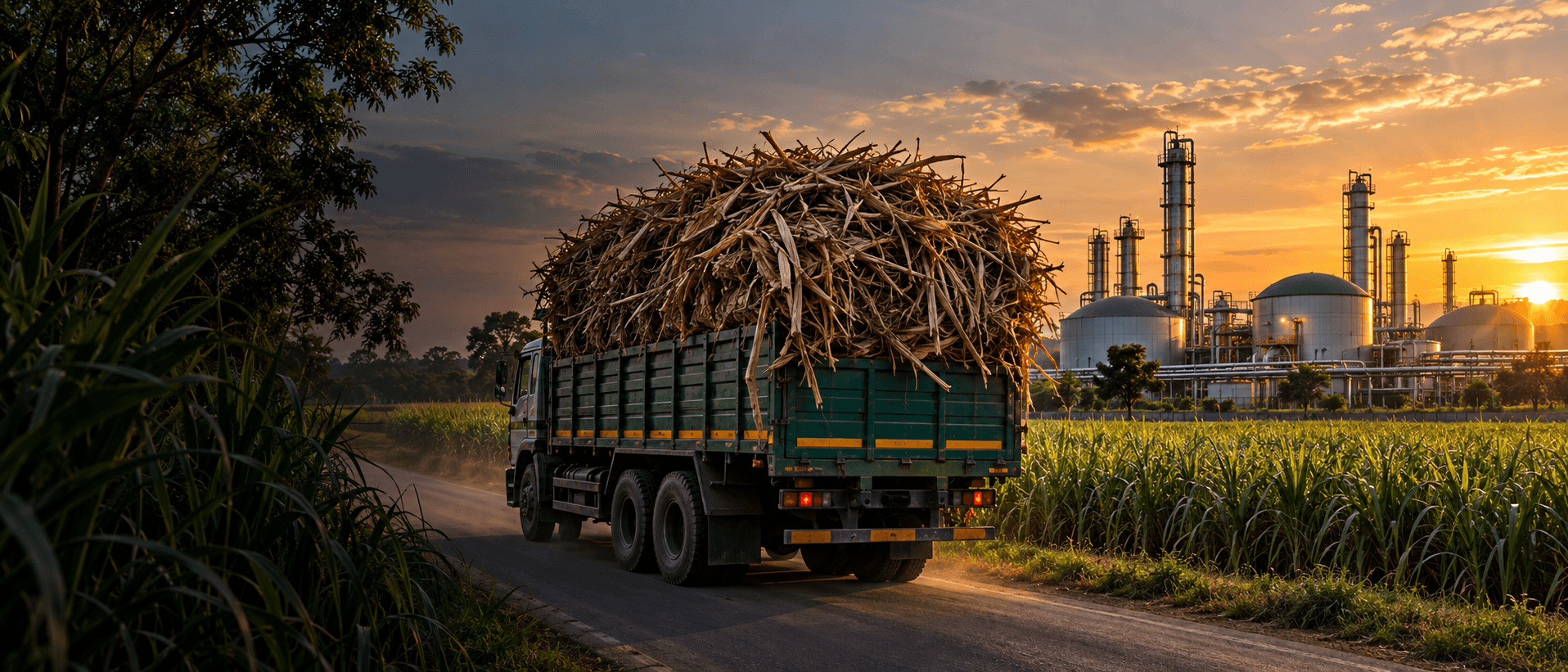
Crop-residue feedstock profile
Sugarcane Trash for CBG: Sourcing and Storage Guide
Sugarcane trash can add a useful field-residue stream in cane districts. Procurement must distinguish it from mill-generated bagasse and press mud, control soil pickup and moisture, and prove the material in the plant's preprocessing system.
Source carefully
Separate field trash from bagasse and press mud; prove clean surplus.
Watch closely
Control soil, stones, moisture, mixed residue and storage heating.
Ask the supplier
Confirm origin, collection method, expected volume and bale quality.
Prepare for feeding
Chop, screen and validate material in the receiving system.
Why sugarcane trash matters
Significant field-residue potential, when recovery is disciplined
Cane leaves and tops can complement other crop residues, support cleaner fields and create supplemental farmer income. Commercial value depends on measured recoverable surplus, clean collection, dry storage and a plant-approved preparation and blend range.
Field-residue potential
Cleaner fields
Farmer income
Diversifies supply
Plant-fit rule
Source + quality + preprocessing + trial
No source cluster becomes execution-ready until all four gates carry dated evidence and plant sign-off.
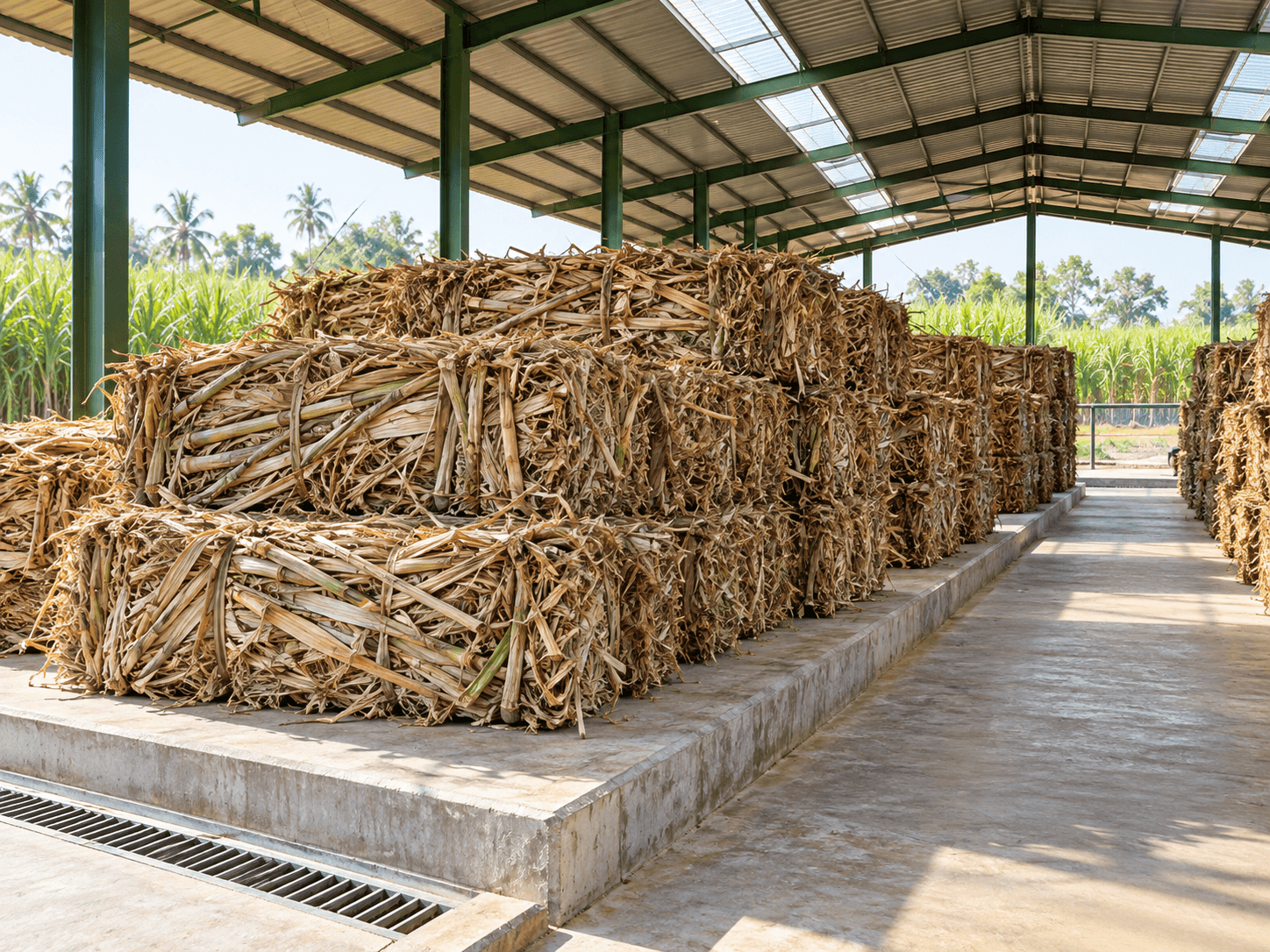
Key feedstock metrics
Planning inputs that must be field-validated
Indicative values vary with cane variety, harvest method, collected fraction, weather, field condition and storage.
75-90%
Indicative total solids for field-dry material; validate each lot
2-6 weeks
Typical collection window after cane harvest
Keep dry
Moisture-sensitive material can deteriorate quickly
Chop + screen
Common preparation for reliable plant feeding
90-160 kg/m3
Indicative transport density for rectangular bales
Field validate
Supplier claims and usable surplus must be proven
Procurement workflow
Prove the chain before contracting annual tonnes
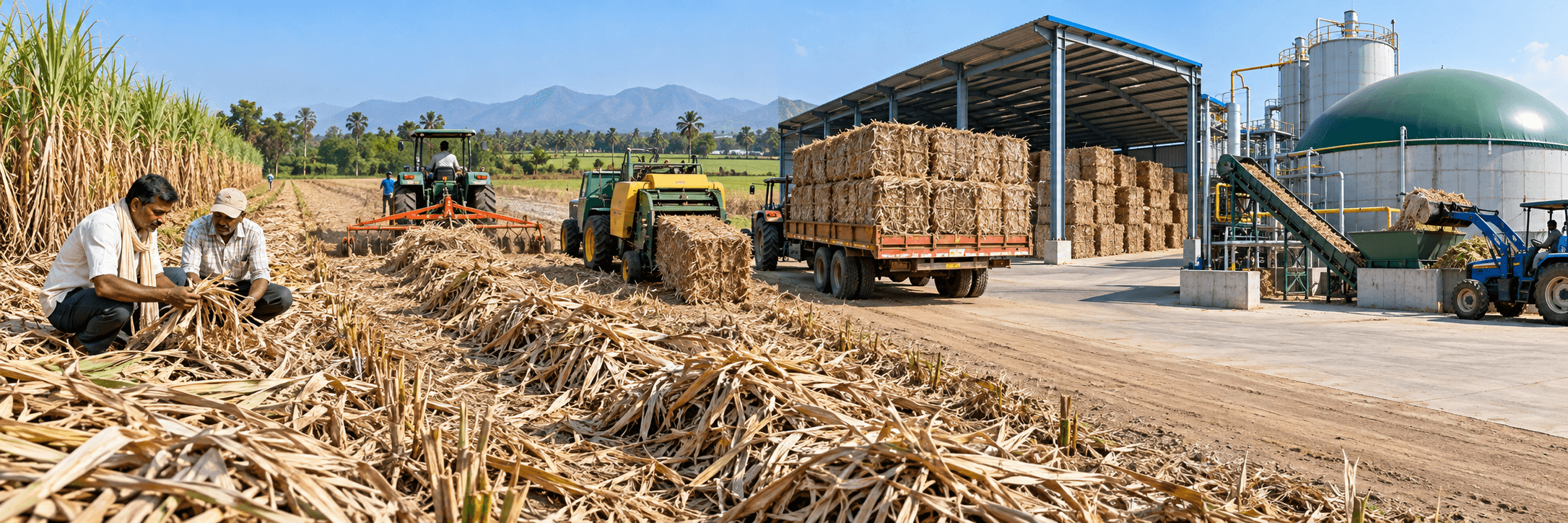
A seven-gate workflow turns a satellite lead into accepted, traceable feedstock.
- 1
Satellite lead
Locate cane clusters and expected harvest windows.
- 2
Field survey
Verify residue identity, access, current uses and clean surplus.
- 3
Supplier commitment
Agree field source, quantity, format, quality and terms.
- 4
Collection and baling
Rake cleanly, bale promptly and assign lot identity.
- 5
Quality screening
Check moisture, soil, stones, mould and mixed residue.
- 6
Storage and dispatch
Keep bales dry, separated, monitored and traceable.
- 7
Controlled plant trial
Prove preparation, feed rate and stable plant response.
Quality parameters
Receiving and traceability controls
Set contract limits from plant design and controlled trial evidence.
| Parameter | Typical range / guidance |
|---|---|
| Moisture content | Target 15% or less for dry storage; contract-specific |
| Soil and stone contamination | Target 5% or less; lower is better |
| Ash / silica risk | Characterize representative field and supplier lots |
| Bale condition | Dry, stable, well-formed and free from visible mould |
| Particle size after preparation | Typically 10-50 mm; plant-specific |
| Undesirable material | Reject plastic, metal, excessive green matter and burnt residue |
| Traceability | Field cluster, harvest date, supplier, lot ID and receiving evidence |
Storage and fire safety
Keep dry inventory stable and accessible
Poor storage can erase the value created during clean collection.
- Store on raised, well-drained platforms with roof or engineered weather protection.
- Use breathable covers and maintain ventilation around every stack block.
- Keep stack spacing, fire breaks and clear emergency access routes.
- Monitor moisture ingress, internal temperature, mould and inventory age.
- Keep ignition sources away and maintain water access and response equipment.
- Apply first-in, first-out dispatch and document every damaged or rejected bale.
Preprocessing and plant readiness
Create a consistent feed fraction
Size reduction improves handling; only trials prove digestion performance.
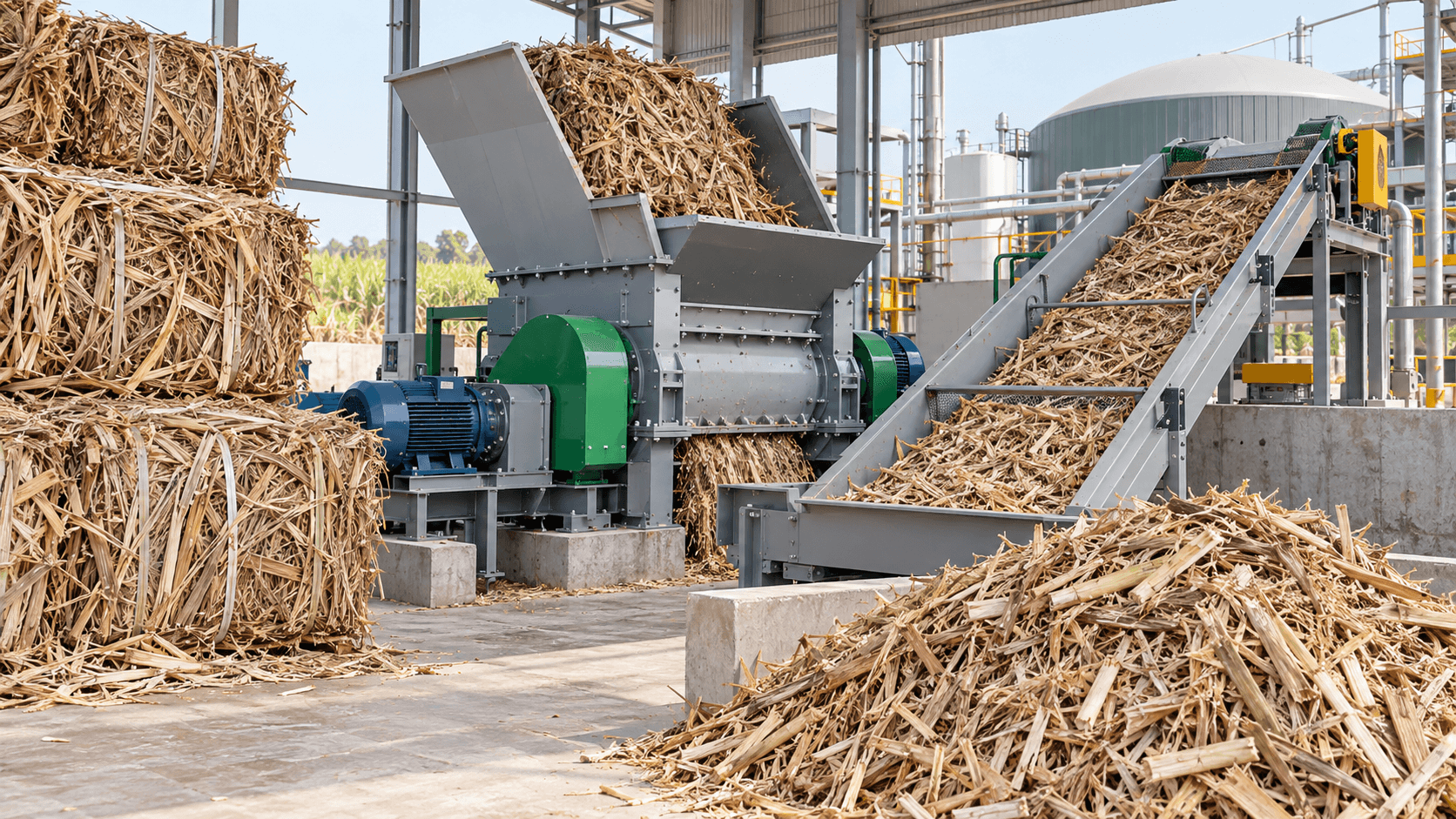
Approval gates
- Stable unloading and conveying
- Consistent screened particle size
- Approved blend and feed rate
- Measured gas and digestate response
Availability and seasonality
Major cane belts and harvest-led collection windows
State context is a lead only. Procurement capacity must be proven at district and field-cluster level.

Major sugarcane-growing states
- 1Uttar Pradesh
- 2Maharashtra
- 3Karnataka
- 4Tamil Nadu
- 5Bihar
- 6Andhra Pradesh
- 7Telangana
- 8Punjab
- 9Haryana
Indicative monthly availability
Illustrative national pattern only; build the dispatch calendar from local mill and field harvest schedules.
Economics
Indicative delivered-cost stack
Recalculate for distance, bale density, accepted weight and regional conditions.
| Parameter | Typical range / guidance |
|---|---|
| Farm-gate price | INR 800-1,500/t |
| Collection and baling | INR 400-800/t |
| Transport within region | INR 300-800/t |
| Chopping / screening | INR 200-500/t |
| Indicative delivered cost | INR 1,700-3,600/t |
These are planning ranges, not live supplier quotes. Verify current cluster prices, equipment utilization, fuel, loading time and rejection loss.
Processing and pretreatment
Choose the least-complex process that meets plant performance
Every process adds cost and operating risk; approve it through measured throughput and digestion trials.
Chopping
- Target plant-approved size
- Improve conveying and feeding
- Reduce bridging risk
Grinding / milling
- Increase available surface area
- Check energy demand
- Monitor silica and wear
Ensiling for mixed systems
- Use only in approved recipes
- Manage moisture deliberately
- Validate storage stability
Advanced pretreatment
- Plant-specific chemistry
- Evaluate safety and cost
- Approve only through trials
How URJA SETU adds value
One evidence chain from satellite lead to buyer acceptance
Bhoomi Drishti
Satellite-led cluster identification
URJA Vision
Supply visibility and planning evidence
Traceability
Source, lot, quality and weight records
Smart hubs
Aggregation and logistics control
Feedstock intelligence
Crop-residue planning by plant
Buyer support
Plant-specific sourcing governance
FAQ
Common sugarcane-trash planning questions
What is sugarcane trash, and is it the same as bagasse?+
Sugarcane trash is dry leaf and top residue recovered from fields. Bagasse is the fibrous material left after cane crushing at a mill, while press mud is a separate filtration residue. Contracts and plant trials must identify the offered stream explicitly.
When is sugarcane trash available?+
Availability follows local cane-harvest calendars and field-access conditions. Use district crop calendars as a lead, then confirm weekly harvest, raking, baler and transport capacity with field evidence.
How should sugarcane trash be stored?+
Use dry, covered, ventilated stacks on raised drained surfaces with temperature and moisture checks, stack separation, fire breaks, clear access and first-in, first-out dispatch.
What are the main quality concerns?+
Moisture, soil and stones, ash and silica, green matter, mould, mixed residues, burnt material and poor bale stability can all affect handling, accepted weight and plant performance.
Does sugarcane trash need preprocessing?+
Most plants will require controlled chopping and screening. Exact particle size, slurry preparation and any further pretreatment depend on receiving, conveying, mixing and digester design.
Is field and plant validation necessary?+
Yes. A field-to-plant pilot should establish recoverable surplus, payload, contamination, handling cost, preparation throughput, safe blend range and stable plant response before annual tonnes are committed.
Ready to assess sugarcane-trash supply for your CBG plant?
Use verified field evidence, supplier commitments, quality controls and plant trials to build a dependable supply plan.
All quantities, ranges and costs are indicative planning inputs, not a plant guarantee, engineering specification, live quote or supplier commitment. Validate local recoverable surplus, representative samples, storage controls and controlled plant trials with qualified professionals.
Evidence sources